We’re happy to share the latest in AltsTech’s series profiling how investment managers are using AI, tech, and analytics to generate alpha. I’m fortunate to interview my Partner Dave Yen, co-founder, Orange Collective.
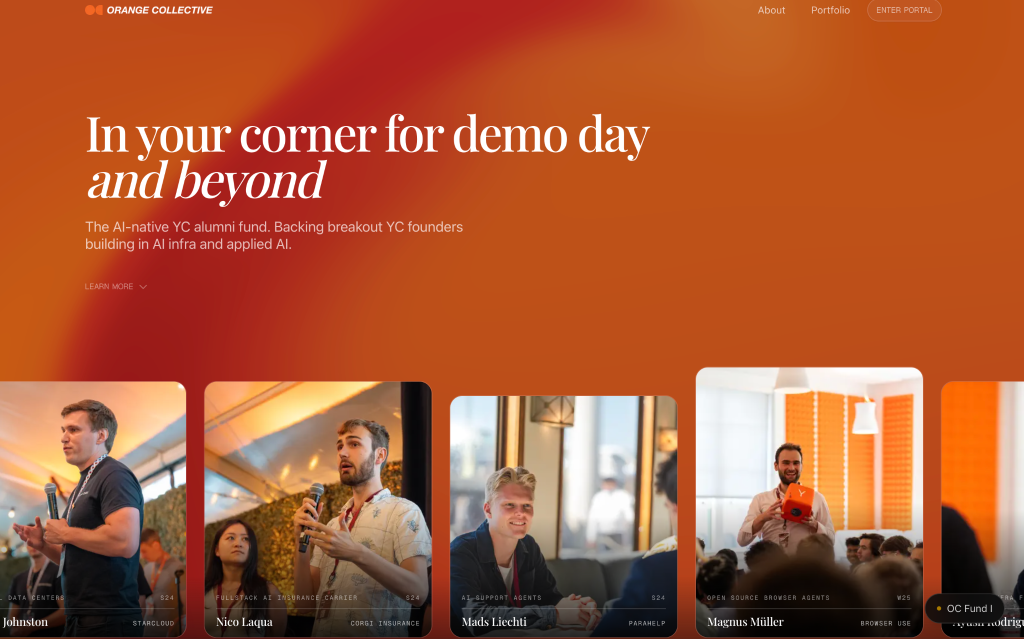
OrangeCollective.vc is a VC fund exclusively investing in AI companies from Y Combinator. YC is the world’s leading tech accelerator; the median multiple of dedicated YC investors is 5x; top decile is 16x. We’re backed by a sovereign wealth fund, growth-stage VCs, family offices, and over 150+ YC grads.
Our LPs evaluate each YC batch and help us gain access to the best companies. When we invest, we share our investment memo with all LPs, making it easy for LPs to co-invest directly at no cost.
Why we built our own software.
Orange Collective invests exclusively in YC companies. Every batch delivers ~200-300 companies on a compressed timeline, and we compete against the best funds in the world to back the strongest teams. Winning isn’t just about cadence — it’s about going deeper on every company and every founder than anyone else, and doing it without a room full of analysts. Off-the-shelf CRMs and research tools gave us neither the speed nor the depth, so we built our own — a platform that uses AI and deep research agents to cover the full batch exhaustively, then go multiple layers deeper on anything that looks interesting.
The platform is AI-native from the ground up. Rather than using agents to speed up a human workflow, we’ve built agents that do the work a team of analysts and associates would do: reading every YC profile, researching every founder, drafting memos, tracking portfolio markups, and publishing our daily outbound — all before we walk into a meeting.
What the agents actually do
A few of our workflows running in production today:
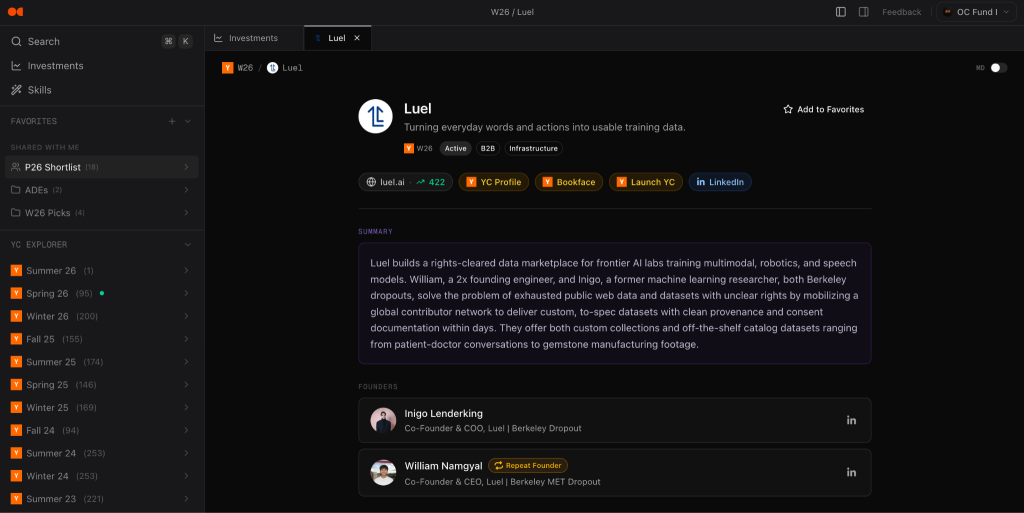
- Company research. A Mastra-orchestrated agent reads every new YC profile and YC Launch page, extracts the problem, solution, founder dynamics, TLDR, web traffic, GitHub repo, LinkedIn profile, and pulls down media — the same first-pass read an associate would do, for every company in the batch, in parallel.
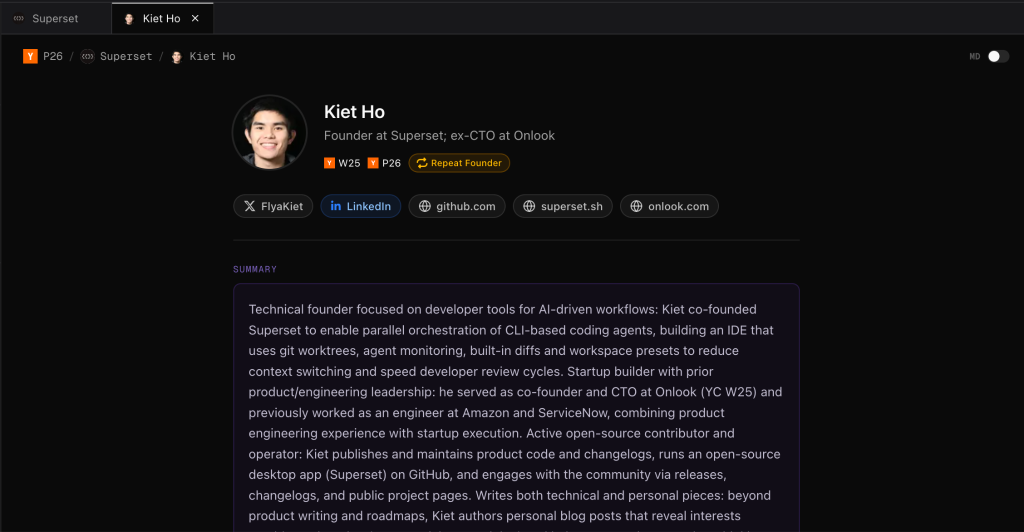
- Founder diligence. For every founder, we pull a full employment and education history, projects, research papers, articles, blogs, and then a second agent re-analyzes the batch to flag repeat founders and prior exits — correcting its own false positives as richer data comes in. This is the hours of per-founder LinkedIn sleuthing an analyst would do, automated.
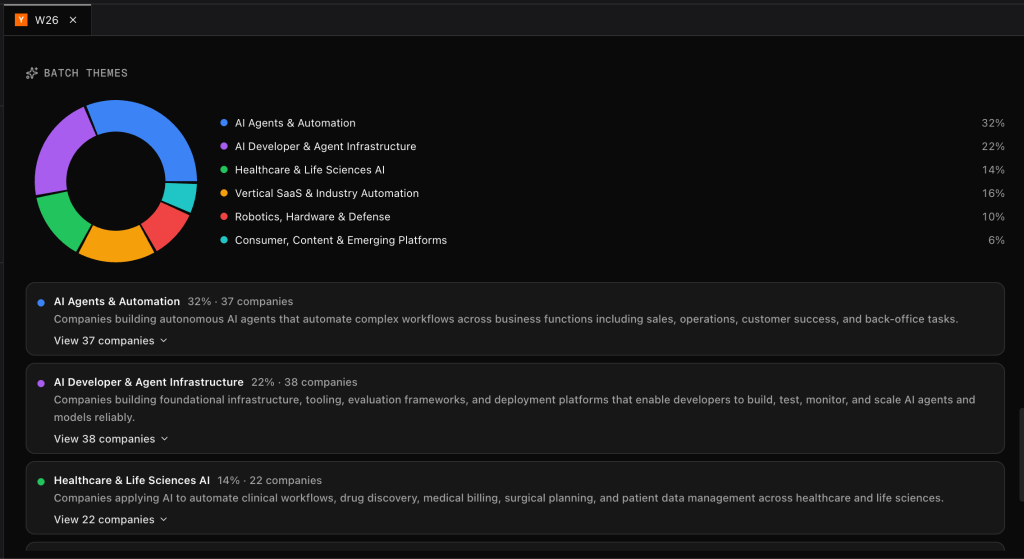
- Batch overview. Every batch has a live dashboard summarizing the cohort at a glance: repeat-founder and prior-exit percentages, top open-source projects ranked by GitHub stars, geographic and industry distribution, and an AI-generated themes panel where Claude clusters the entire batch into 4–6 thematic groups (e.g. “AI Infrastructure”, “Healthcare Automation”) with the specific companies that belong in each. It’s the fastest way we’ve found to orient a new batch in under a minute.
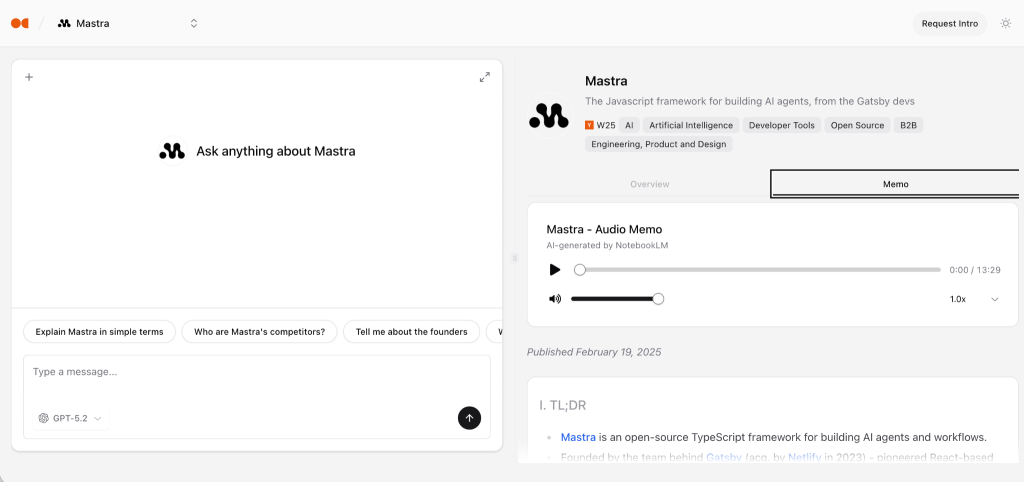
- Memo drafting. Every company carries a versioned memo. The research agents produce a pre-assembled draft — problem, solution, founder history, competitive context — so a Partner starts from 80% instead of a blank page.
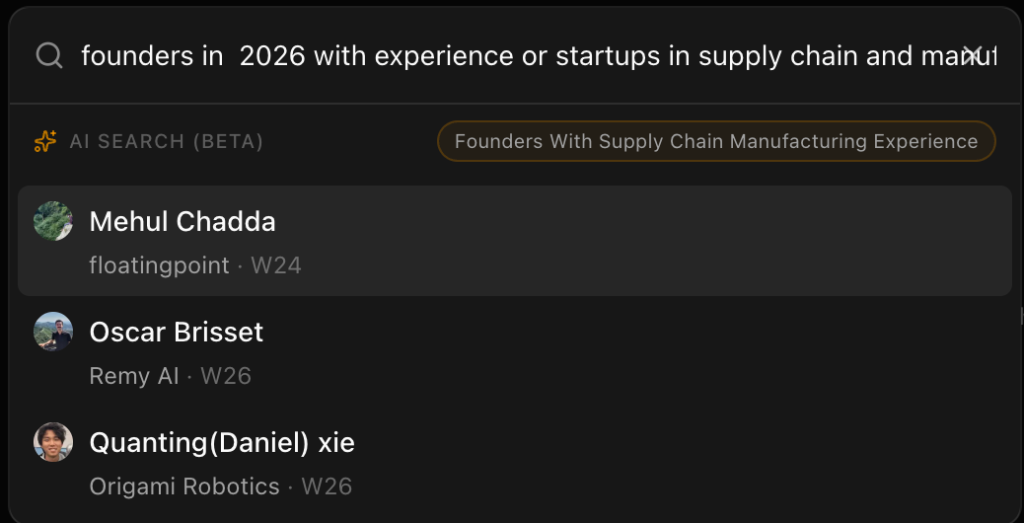
- Agentic search. An agent parses natural-language queries like “founders in 2026 with experience or startups in supply chain and manufacturing” into structured filters, then runs them across our company and founder data — including inside employment and education histories.
- Chat with context, anywhere. A built-in AI chat lets any partner @mention a company, founder, or entire team to pass it as context, then /invoke a Skill — a reusable prompt our team has authored for recurring jobs like company comparisons, competitive landscape write-ups, or founder deep-dives. Skills can be private, shared with a team, or public across the fund, and usage is tracked so the best ones rise to the top.
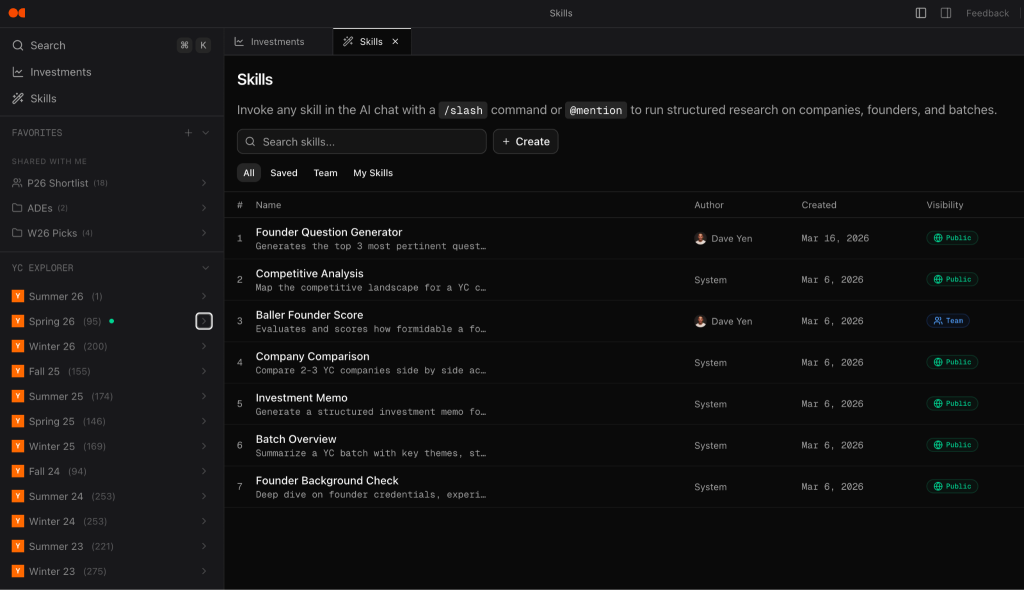
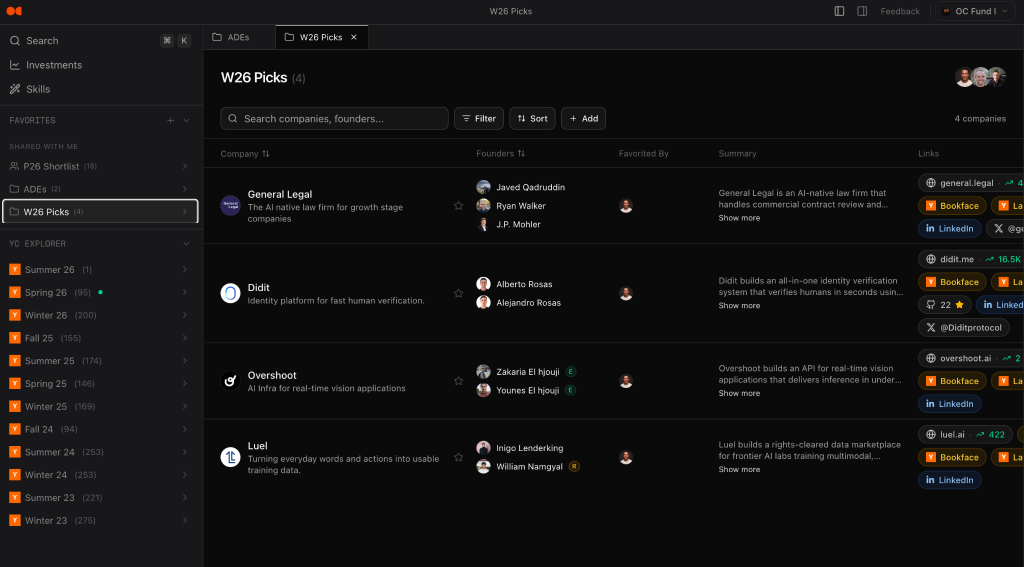
- Favorites folders, private or collaborative. Every partner can organize companies into folders — kept private for personal watchlists, or made collaborative so an entire team can co-curate a list in real time. This matters more than it sounds: Orange Collective has 150+ YC-alumni LPs, many of whom are active angels, founder-turned-VCs, or now full-time partners and GPs at top VC funds. Collaborative folders turn that network into a live signal layer — our LPs flag companies they’re excited about, and we see the consensus forming as the batch unfolds.
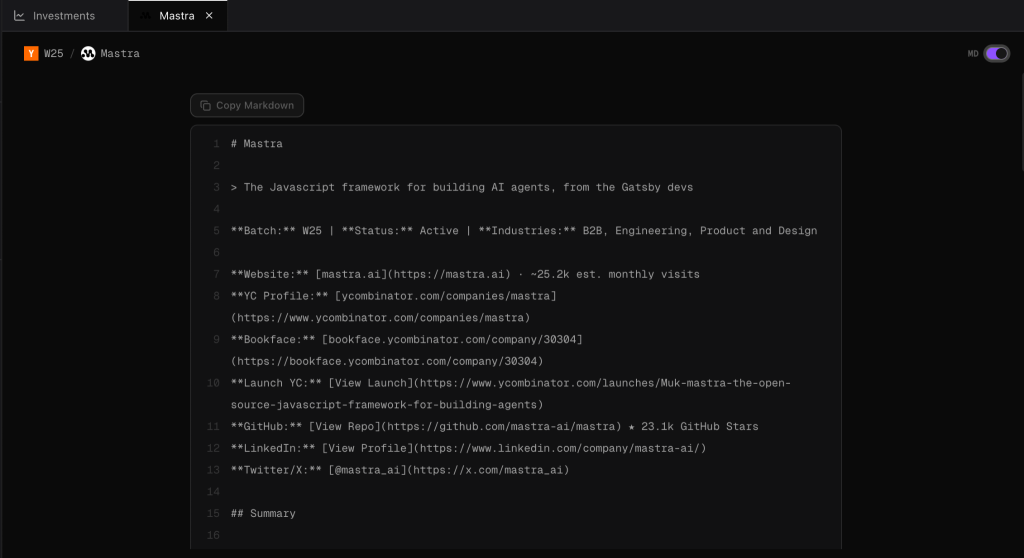
- Agent-friendly markdown mode. Every company and founder page has a one-click “MD” toggle that flips the entire profile into clean, copyable markdown — so a partner can paste a fully structured research packet into Claude, ChatGPT, or any other tool in a single keystroke.
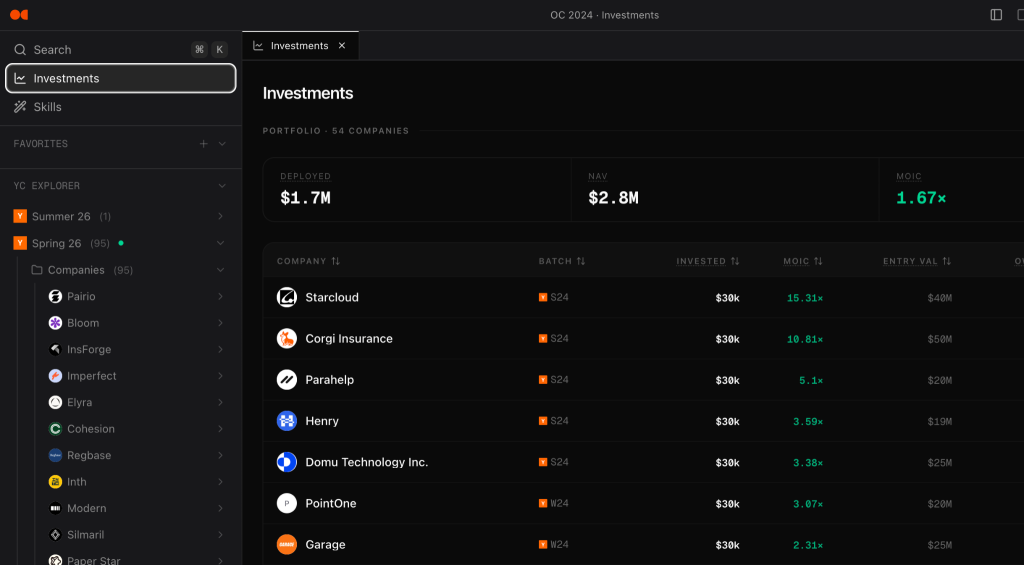
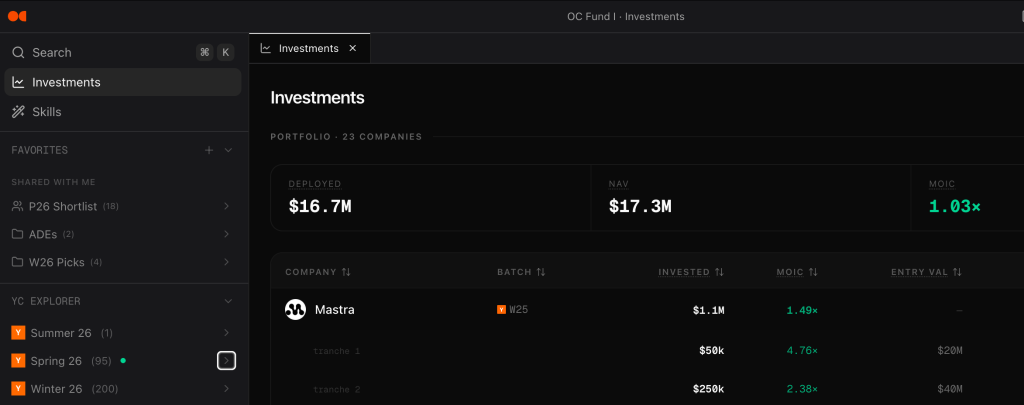
- Portfolio tracking. Lifecycle-aware investment models handle SAFEs, follow-ons, markups, and conversions automatically, with amount-weighted cap multiples and mark-to-market stats computed from a single source of truth.
- Daily scouting. An email digest and an X/Twitter thread agent compose and publish a thematic summary of every newly launched YC company, every day — both authored by agents, reviewed by us.
Each of these is a job that traditionally takes an analyst or associate. Running them as agents means we operate as if we had a larger team — without the coordination overhead.
Why this is a durable edge
Three reasons:
- Agent leverage. Our partners spend their time on judgment calls and founder relationships, not grunt work. Every new capability is another agent plugged into the same platform.
- Coverage where it matters. Generalist tools like PitchBook, Affinity, and Crunchbase have almost nothing on the companies we care about — a startup that launched three weeks ago, or a founder who just dropped out of college last month, doesn’t exist in their databases yet. By the time they do, the round is long gone. We index the universe the day it becomes visible on YC, enrich it the same hour, and every prompt, column, and query is tuned for how YC companies and founders actually look.
- Hands-on experience is the best diligence. Building with Mastra, Claude, Firecrawl, and the rest has been — by a wide margin — the most valuable diligence investment we’ve made. We recognize architecture decisions in 30 seconds because we’ve made the same ones ourselves last quarter. Founders notice immediately when an investor has actually shipped the thing they’re building, and it changes every conversation we have with the strongest AI teams in the batch.
What’s next
We’re pushing in two directions simultaneously:
- Better agents, deeper integrations. More capable research, diligence, and portfolio-intelligence workflows, with richer integrations across the tools our partners and founders already use. As foundation models improve, these agents compound for free.
- A scored, feedback-looped dataset. Today our platform describes companies. The next step is to quantify and score them — building a structured dataset of signals (founder background, traction, market, team dynamics, outcomes) that we can use to rank and benchmark every YC company, past and present.
The interesting question is whether we can go further and treat the platform as a reinforcement learning environment with a verifiable reward. Every investment we make — and every company we pass on — eventually produces a ground-truth outcome: markups, exits, follow-on rounds, flame-outs. If we can close the loop between the agent’s initial scoring and the actual result, we get something unusual: an evaluation environment for investment decisions, with a real reward signal, running continuously on new batches.
Most funds can’t do this because they don’t have a programmatic scoring pipeline or the data to train against. We’re specifically positioned to — and we think it’s where the next decade of alpha in early-stage investing is going to come from.
Further reading:
